
English

Views: 145 Author: Site Editor Publish Time: 2026-04-29 Origin: Site
Selecting a cleanroom goes far beyond a basic engineering checklist. It serves as a vital capital expenditure tied directly to regulatory compliance, product yield, and business scalability. Choosing the wrong classification or structural build invites massive financial and operational risks. You might face failed compliance audits, sky-high energy bills, or highly disruptive facility retrofits down the line. Such mistakes drain budgets and drastically delay your time-to-market.
To make an informed, risk-averse procurement decision, facility managers must evaluate their options systematically. We will examine cleanroom facilities across three crucial lenses: construction architecture, airflow dynamics, and industry-specific regulatory standards. By the end, you will learn exactly how to align your environmental controls with your specific production demands.
Cleanrooms are categorized by structural build (e.g., modular cleanroom vs. stick-built), airflow design (unidirectional vs. turbulent), and regulatory class (ISO, EU GMP, USP).
A modular cleanroom (specifically hardwall) offers a lower Total Cost of Ownership and faster deployment compared to traditional drywall construction, with built-in flexibility for future scale-ups.
Achieving strict ISO 5 or EU GMP Grade A compliance exponentially increases HVAC demands (e.g., 300+ air changes per hour) and mandates restrictive personnel gowning protocols.
Softwall cleanrooms provide cost-effective localized particle control but lack the rigid environmental controls (temperature, humidity, pressure cascades) required for advanced biopharma or semiconductor processing.
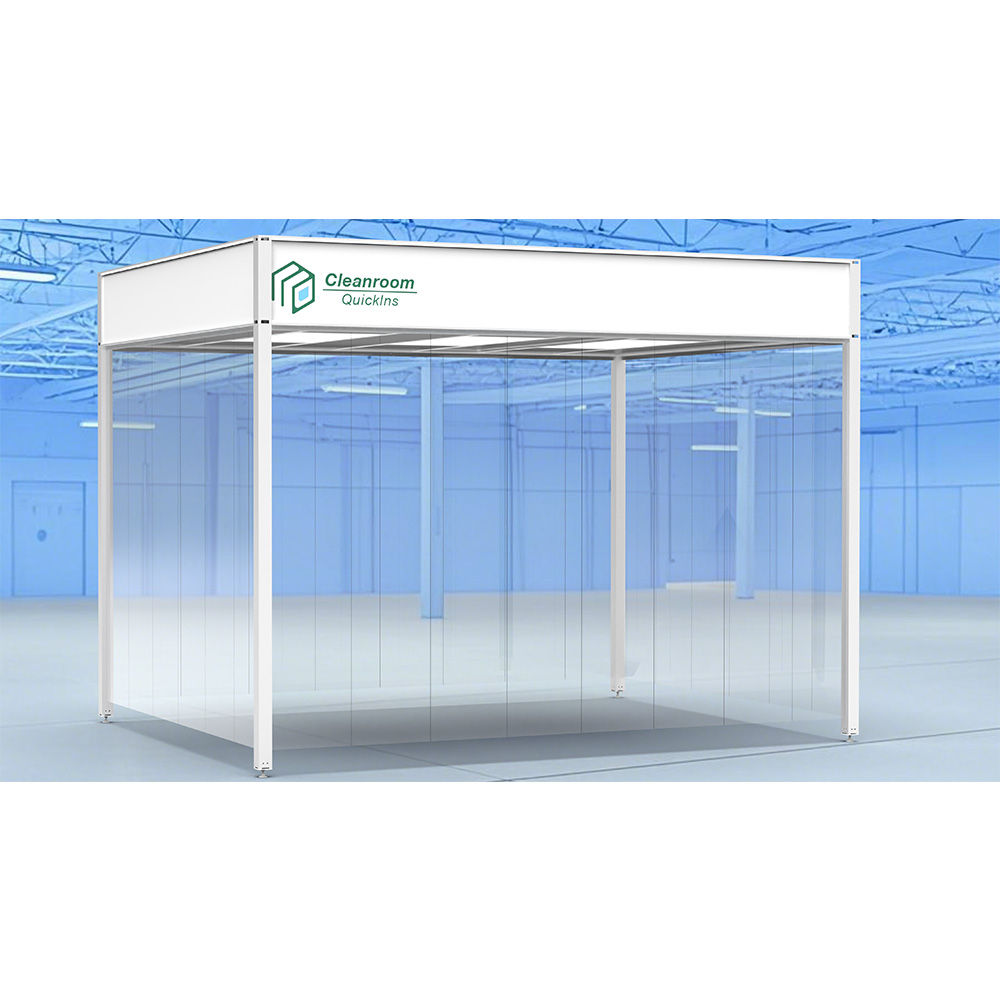
The physical structure of your facility dictates deployment speed, upfront CapEx, and long-term adaptability. Facility leaders must carefully weigh these factors before finalizing any blueprints.
Hardwall systems use prefabricated, rigid wall panels. Manufacturers typically construct these panels from aluminum, steel, or specialized fiberglass reinforced plastic (FRP). They interlock seamlessly to create a tightly sealed environment.
This architecture is ideal for scaling. Choosing a modular cleanroom offers predictable installation timelines. It also simplifies tax depreciation. Auditors often classify these modular units as capital equipment rather than permanent building infrastructure. Furthermore, hardwall structures give you strict control over pressure cascades, temperature, and humidity. They easily meet the stringent demands of advanced manufacturing.
Softwall configurations rely on heavy-duty vinyl curtains. You suspend these curtains from a freestanding, lightweight frame.
They are incredibly cost-effective. You can usually establish a baseline softwall setup for $5,000 to $10,000. They are also highly mobile. This makes them perfect for localized zones, often called mini-environments. They work best for low-grade requirements targeting ISO 7 to ISO 8. However, they carry significant trade-offs. Softwall systems cannot reliably maintain stringent temperature and humidity levels. They also struggle to hold positive or negative pressure differentials.
Contractors build stick-built structures directly into a facility's permanent architecture. They use epoxy-painted drywall and conventional metal studs.
Organizations typically reserve this approach for massive, permanent legacy facilities. Yet, it carries severe risks. Stick-built rooms are highly disruptive to modify. Over decades, structural settling causes micro-cracking in the drywall. This shedding releases unwanted particulates into the environment. Additionally, stick-built projects suffer from much longer, unpredictable construction timelines.
Construction Architecture Comparison
Feature | Hardwall Modular | Softwall Modular | Stick-Built |
|---|---|---|---|
Wall Material | Rigid panels (Steel, Aluminum, FRP) | Vinyl curtains | Epoxy-painted drywall |
Max Cleanliness | ISO 1 to ISO 9 | ISO 7 to ISO 9 | ISO 4 to ISO 9 |
Flexibility | High (Easy to expand/relocate) | Very High (Highly mobile) | Low (Permanent structure) |
Pressure Control | Excellent | Poor | Good (but degrades over time) |
Airflow engineering dictates your Fan Filter Unit (FFU) coverage. It directly impacts energy consumption and establishes your maximum achievable cleanliness limit.
In laminar systems, air moves strictly in one direction. Usually, it flows downwards at a constant velocity of 0.3 to 0.5 meters per second. This consistent physical barrier flushes particles immediately out of the room. The air typically exits through raised ventilated floors or low-wall return grilles.
This mechanism heavily impacts your TCO. You will face high energy consumption. Laminar environments require 60% to 100% ceiling FFU coverage. They also demand staggering turnover rates, sometimes reaching 360 to 600 Air Changes Per Hour (ACH). Because of this cost, facility managers reserve laminar flow exclusively for high-risk processes. Typical applications include microchip wafer fabrication and critical sterile compounding.
Turbulent systems do not push particles in a straight line. Instead, they rely on random air mixing. Incoming clean air dilutes existing particle concentrations. Once diluted safely, the system exhausts the mixed air.
This design offers considerably lower operating costs. You only need 5% to 25% FFU ceiling coverage. The required ACH drops significantly, typically ranging from 10 to 180 changes per hour. We see turbulent systems as the standard for general manufacturing. They perfectly suit medical device packaging, e-liquid bottling, and CBD extraction facilities.
Classifications are never mere suggestions. They act as strict benchmarks enforced by the FDA, EMA, and independent ISO auditors. Failing to meet them halts production immediately.
This standard governs nearly all global particle control metrics. It ranks environments from ISO 1 (the strictest) down to ISO 9 (equivalent to normal room air). The ranking depends entirely on the maximum allowable particles per cubic meter. For industrial manufacturing, ISO 7 and ISO 8 represent the most common operational targets.
You must follow these guidelines if you manufacture pharmaceuticals or biotech products for the European market.
Grade A: Reserved for high-risk operations like aseptic filling zones. It requires a constant 0.45 m/s laminar flow to physically block microbes.
Grade B: Serves as the immediate background environment for Grade A zones.
Grade C and D: Function as secondary background environments. They feature distinct "at-rest" versus "in-operation" particle thresholds.
These standards apply strictly to healthcare facilities and pharmacy compounding. They focus heavily on hazardous drug containment. Passing these audits requires specific architectural features. You will need negative pressure environments and multi-chamber airlocks to prevent toxic vapors from escaping into hospital corridors.
ISO to EU GMP Cross-Reference Chart
ISO 14644-1 Class | EU GMP Annex 1 Grade | Airflow Type | Typical ACH |
|---|---|---|---|
ISO 5 | Grade A / Grade B (at rest) | Unidirectional (Laminar) | 240 - 600 |
ISO 7 | Grade C | Turbulent | 60 - 90 |
ISO 8 | Grade D | Turbulent | 15 - 60 |
Different industries prioritize different types of contamination control. Some fight invisible particles, some battle living microbes, and others wage war against ambient moisture.
Microchip foundries require absolute particle eradication. They utilize Ultra-Low Penetration Air (ULPA) filtration to catch nano-scale debris. They also rely on static dissipative (ESD) materials to prevent electrical shorts. Many modern facilities utilize massive "Ballroom" modular designs. These large open areas house highly localized mini-environments over critical machines. Furthermore, lithium-ion and semiconductor plants require "Dry Rooms." These specialized rooms integrate powerful desiccant dehumidifiers to maintain a relative humidity below 1%.
Life sciences focus primarily on microbial control. Your facility must feature seamless, coved corners to prevent bacterial buildup and enable rigorous chemical sterilization. Personnel are the largest contamination risk here. Therefore, biotech facilities require extensive gowning anterooms. Workers follow strict multi-step gowning procedures before entry. These rooms must maintain precise positive pressure validation to keep dirty air out.
Sectors like cannabis cultivation, lithium-ion battery assembly, and e-liquid production face unique challenges. They focus on preventing cross-contamination, managing intense odors, and maintaining basic particulate dilution. These rapidly growing sectors benefit immensely from fast-deployment strategies. Usually, they find their best ROI by deploying an ISO 7 or ISO 8 modular cleanroom.
Moving from preliminary research to actual procurement requires strict evaluation logic. Facility leaders should follow these three essential steps to prevent costly misalignments.
Define the Process Constraint: You must identify your primary enemy. Are you trying to control viable micro-organisms, non-viable dust particles, or hazardous chemical vapors? Viable microbes dictate seamless epoxy floors and heavy sterilization protocols. Non-viable particles dictate high-volume air changes. Chemical vapors dictate negative pressure exhaust systems.
Calculate the Gowning Burden: Human skin and hair represent the number one source of cleanroom contamination. A strict ISO 5 environment requires double or even triple sterile gowning. This rigorous protocol necessitates an architecture equipped with multiple cascading anterooms. You must design enough physical space to accommodate these transitional areas.
Evaluate Life-Cycle Flexibility: Think beyond your current fiscal year. If your production volume or compliance targets might shift in the next three to five years, you need an adaptable infrastructure. A rigid modular cleanroom provides the necessary pivot-ability. You can expand it, upgrade its HVAC load, or relocate it entirely. Permanent stick-built structures trap you into a rigid footprint.
Understanding the precise intersection of construction type, airflow dynamics, and regulatory class is paramount. It serves as your strongest defense against over-engineering your facility or under-complying with federal mandates.
For the vast majority of modern scaling businesses, we strongly advise against permanent stick-built structures. A rigid modular system strikes the optimal balance. It delivers rapid deployment, ensures validated compliance, and provides a highly predictable TCO.
Evaluate your true process constraints before requesting contractor quotes.
Map out your personnel workflow to ensure you have adequate gowning space.
Prioritize structural flexibility to protect your CapEx investment against future scale-ups.
Schedule a facility layout review or request a specification consultation with an engineering team to map your exact ISO/GMP requirements today.
A: Hardwall panels offer rigorous pressure and climate control. They easily achieve the high-level ISO and EU GMP compliance required for critical manufacturing. Softwall structures use suspended vinyl curtains. They are significantly cheaper but functionally limited. They provide basic, localized particle dilution and generally max out at ISO 7 or ISO 8 classifications.
A: Yes, if you use a modular cleanroom. Upgrading requires adding more Fan Filter Units (FFUs) to increase your air changes per hour. You might also need to upgrade the HVAC system to handle the added thermal load. Modular ceiling grids easily accommodate these physical equipment additions.
A: Unidirectional (laminar) flow physically pushes contaminants away from critical zones without mixing. You must use laminar flow to pass ISO 5 or stricter audits. Turbulent flow mixes incoming clean air with contaminated room air to dilute it. Auditors only accept turbulent designs for ISO 6 and above.


